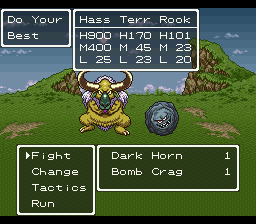
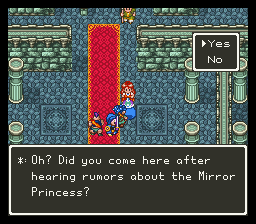
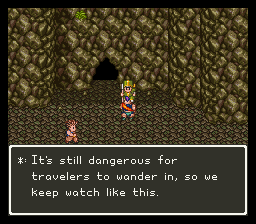
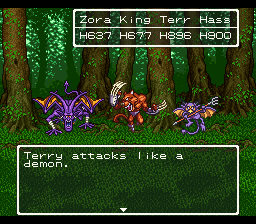
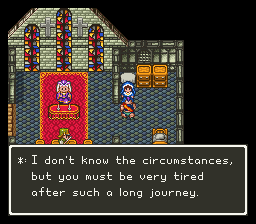
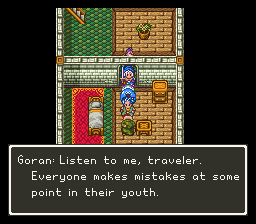
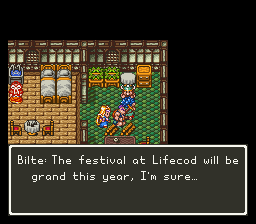
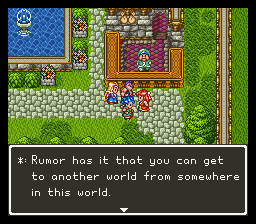
This project aims to improve upon the work of NoPrgress' fan translation of Dragon Quest VI in a few substantial ways. The first attempt was quite good in my estimation (and very impressive for how early of a translation it was), but many things can be updated now:
AI will not be used for any of the text translation in this project
This project is being worked on now. If you have questions, message on Bluesky or email cleartonic@gmail.com


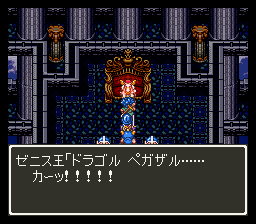
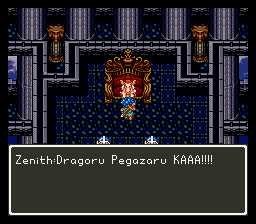
This version is named the "Pegazaru" version, named after the spell incantation that King Zenith performs to restore Falshion to its legendary Pegasus status.


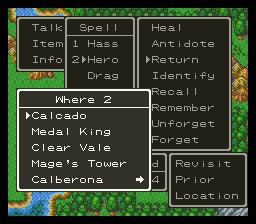
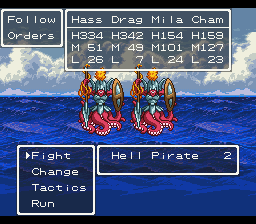
Both spell and skill names, and their 3 line descriptions, were overhauled. Some names were perfectly fine, but others needed to be adjusted to both be consistent with other entries in the series and to actually be helpful descriptions. In the original Japanese description text for each entry, it is at best some flavor text in most cases that describe the skill, but many of them do say directly or imply how many targets are affected. As much as possible, I've included the targeting of skills in the 3rd line to reflect this. A lot of the time the name alone is enough to figure out what a skill is doing, and the flavor text isn't all that helpful. Most players can understand that something called "Flame Slash" is going to be a physical attack that does fire based damage - you don't really need much to describe it. But for many skills, the targeting is nebulous based on the name and it's good to know which skills impact which targets. So I made it a priority to try to include targeting.
Here we have two examples - the first image shows Blazemost with the simple targeting updates in the description. This image also shows some renaming like Thordain and Alldain. Thordain is unfortunately a little confusing - in DW4 it refers to what is effectively Alldain now, and in every entry onwards from DWM it refers to the group targetting Electric damage spell (ギガデイン, Gigadein). So here we name it Thordain, and thus next to it we have Alldain (ミナデイン, Minadein, where "mina" refers to the Japanese word for everyone) matches DW7.
In the second image, the infamous "Magiblade" has been properly named to "EvilSlash". Magiblade was a mistranslation of "Majingiri", roughly "devil slash", but the translation thought "majin" meant something like "magic" and thus named it Magiblade and came up with a random description for it. It's simply EvilSlash, the same skill as Hatchet Man/Thunder Thrust in modern localizations.


Most item names aren't changed. Some of them had "*" characters in them for some reason, and they've been removed. In the first image, the "Spear of Glacos" was renamed "Gracos Spear", mostly to reflect changing Gracos' name to be consistent with DW7.
The second image above shows renaming the fan translation's "Calbero Boot" to "Calbero Bute". The "Bute" (ビュト, "byuto") is a reference to the Sentai Gorenger series, where the Red Bute is a whip-like weapon. In the modern localizations, they have renamed this whip "wizardly whip", even though it's Japanese name is perfectly consistent across ever entry it appears in. So not only did we lose the reference to Calberona, the in-game DQVI location with a cool whip that Barbara can use, we also lost the Sentai reference. So naturally we preserve it here.
Let's take a look at this example of Rubiss, the mysterious figure who appears during the Lifecod festival early in the game. Rubiss appears to tell the Hero about his destiny to save the world from dark forces, and a few other important notes. Rubiss talks about the Hero needing to seek out his true self, which most translations handle fine. But one of the most important details is about the mystery of the worlds:

Specifically this line: "閉ざされた なぞを……" which talks about a mystery that is unsolved or kept intentionally secret, sealed in some way. In context of the game, this is very intentionally talking about the strangeness of the two worlds, where up until this point of the story, the player has experienced their starting "normal" world and this other world where they have no tangible identity. This game's proper subtitle is "Maboroshi no Daichi", which is roughly "The Phantom World", and Rubiss is directly informing the player that they've got work to do to figure out this mystery.


On the left is the NoPrgress fan translation, and on the right is the official NDS localization. Neither of them really get this right - NoPrgress doesn't explore this concept at all. The NDS version sort of gets at the idea of some sort of deception on behalf of Deathmore's generals (Dread Fiends as they are called in NDS, a made up term not present in either the SFC or NDS Japanese versions). But this text is not really pinpointing at the same message of the original. "Deceptions" is a general word for the bad guys obsfucating their plan - but in context, the mystery of the phantom world (dream world) existing and its nature is what is actively talked about by many NPCs, and I don't think "deceptions" really gets at that at all. Instead, the point of the original text is to inform the Hero (and thus the player) that there is in fact a big mystery at play, and it's time for them to unearth it.
During the prologue, we are introduced to Milayou (Milly) and Hassan (Carver), the Hero's companions. Their dialogue offers a small flavor of their personalities - Milayou is calm and wise, and Hassan is cautious but fired up to take on Mudo, their target. His second dialogue is as follows:


His dialogue is "ちょっと まわりを見てきたけど やっぱ あの城に まちがいないようだぜ。" - it's him saying that without any doubt, they found the castle they were looking for. It has some parts of it that suggest he has a somewhat informal tone, but he's confident in his answer. It's not a particularly complex translation - the base idea that he looked around and confirmed that the castle they were looking for is the one they're at is all that it really is, with a little flair about his personality.


The NoPrgress translation handles this fine. Again, it's a basic dialogue sequence and it's not overly complex to convey this idea. It doesn't do much to highlight some of his personality, but it's hard to do that with this kind of sentiment. There are some language differences from Japanese to English, and it's generally OK if it gets missed here but picked up later - we all have to make concessions about language differences sometimes, and that's OK.
But the NDS localization is egregious and actually makes me upset for many reasons. They got the idea right about the actual content at the end, but they introduce this character trait of Hassan is basically stupid, that he's stammering on big words. And it's hardly just this text box that introduces this idea, but remember this is literally the second text box from this character within a minute of starting the game.
Hassan is surrounded by characters who are generally wiser than him. But he is by no means stupid, and no part of the original text supports this. In fact, it's quite the opposite - consider the fact that in the backstory of the game, Hassan left his home of San Marino in his life as an apprentice carpenter to help rid the world of Mudo's grand designs. A display of courage and willpower. When leaving the Reidock throne room after defeating Mudo in the dream world, Hassan calls out to the Hero some thoughts he has about why the King of Reidock isn't present in the dream world any longer, but leaves it to the Hero (thus the player) to figure out the final connection. There's nothing to suggest that he's unintelligent. His main character traits are that he is a little informal and brash with his dialogue, especially with some dialogue he has with Granmaz, but he's also contemplative and faithful in his allies. So whatever the NDS localization decided to do to "dumb him down" is really upsetting, and most importantly not supported by either of the original texts, SFC or NDS.